PDAF vs. CDAF: What’s the Difference and Why Does It Matter for PTZ Cameras?
Oct 05 2026

 Autofocus is something we often take for granted. Point the camera at a subject, and within moments, the image becomes sharp.
But behind that simple experience is a sophisticated process: How does a camera know whether the subject is in focus, and how does it know where to move the lens?
Two of the most common autofocus technologies are Contrast Detection Autofocus (CDAF) and Phase Detection Autofocus (PDAF).
Both are designed to achieve sharp focus, but they approach the task very differently. Understanding that difference becomes especially important for PTZ cameras, where subjects, framing, zoom positions, and camera angles can constantly change during a live production.
CDAF, or Contrast Detection Autofocus, determines focus by analyzing contrast in the image.
The principle is straightforward: an image generally reaches its highest contrast when it is correctly focused.
The camera evaluates the image from the sensor and moves the lens while monitoring the level of contrast. If contrast increases, it continues adjusting in that direction. Once contrast begins to decrease, the camera knows it has moved beyond the optimal focus position and adjusts again.
In simplified terms:
Measure contrast → Adjust the lens → Measure again → Find maximum contrast
CDAF can provide highly accurate focus because it evaluates the actual image produced by the imaging sensor.
However, there is an important limitation.
When the image is out of focus, a conventional CDAF system does not inherently know exactly which direction the lens should move or how far it needs to travel. It may therefore need to search for the optimal position.
This can sometimes result in the lens moving back and forth before settling on the subject—a behavior commonly known as focus hunting.
PDAF, or Phase Detection Autofocus, approaches focusing differently.
Instead of searching for the point of maximum contrast, PDAF compares phase information from incoming light.
From this phase difference, the autofocus system can determine important information about the focus error, including:
In simplified terms:
Detect phase difference → Determine direction and amount → Move toward focus
Rather than searching back and forth for the optimal position, the autofocus system has information that allows it to drive the lens more directly toward the correct focus.
This is why PDAF is particularly effective when fast autofocus response and continuous subject tracking are required.
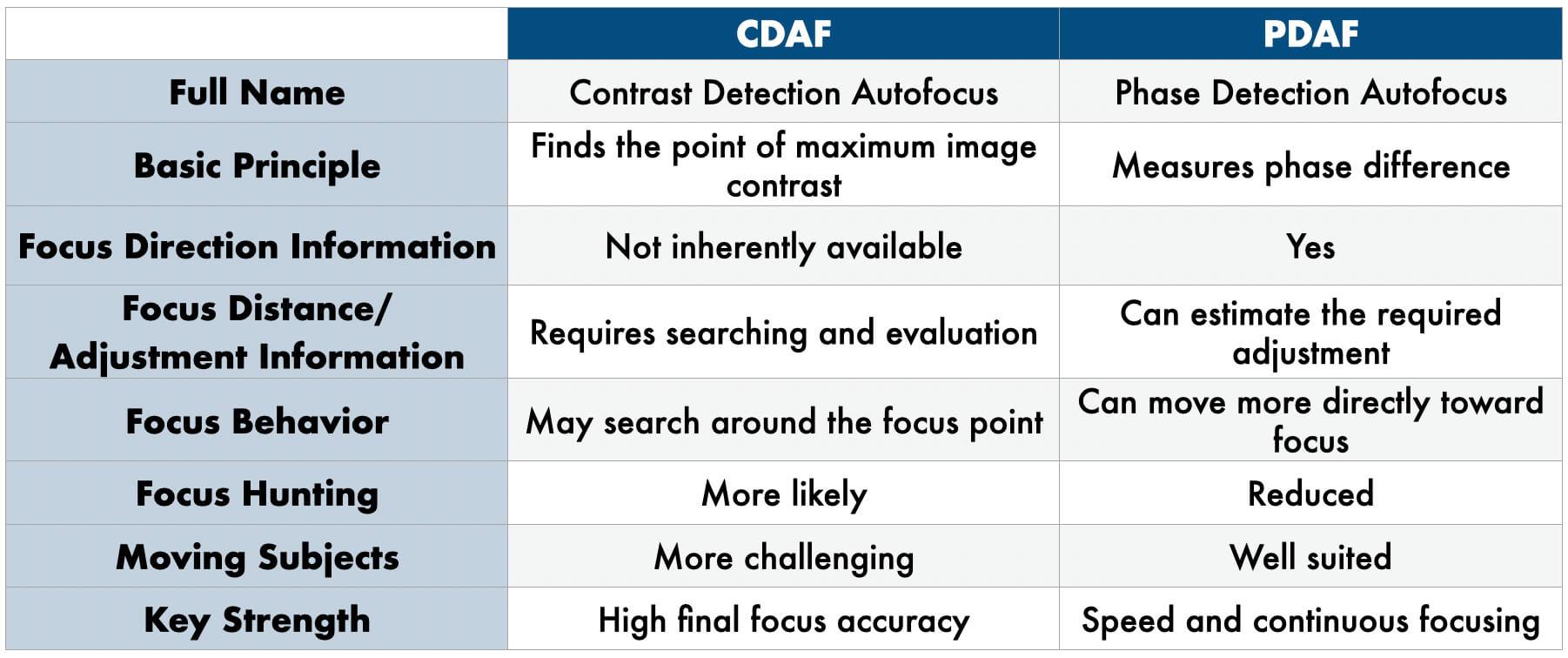
The key difference is therefore not simply which technology is "more accurate."
The real difference is how the camera determines where the correct focus position is.
CDAF searches for it.
PDAF can determine how the lens needs to move toward it.
For a fixed camera shooting a stationary subject, autofocus may not need to work very hard.
A PTZ camera is different.
During a live production, a PTZ camera may need to:
Each of these actions can change the camera-to-subject distance, composition, or focus requirement.
That means autofocus performance becomes an important part of the PTZ camera's overall performance.
Consider a Simple Example
Imagine a presenter walking toward the camera while the PTZ camera tracks the person and gradually zooms in.
The subject's position and required focus are continuously changing.
A contrast-based system may need to repeatedly evaluate the image and adjust focus as the subject moves.
PDAF provides directional focus information, helping the autofocus system respond more directly as the focus distance changes.
For viewers, the difference can mean a more stable, natural-looking image with less noticeable focus searching during the shot.
Sensor size also changes the autofocus equation.
Larger sensors, particularly when combined with wider apertures and longer focal lengths, can produce a shallower depth of field.
This creates the attractive separation between a sharply focused subject and a softer background that many productions associate with a more cinematic image.
But shallow depth of field also leaves less room for focusing errors.
If the subject moves forward or backward, even a relatively small change in distance can make the subject appear soft.
This creates an interesting challenge for professional PTZ cameras:
The more cinematic the image becomes, the more important reliable autofocus becomes.
Fast and responsive autofocus therefore complements the creative possibilities offered by a larger imaging sensor.
This is where PDAF becomes particularly relevant to the Datavideo PTC-700G.
Designed for professional 4K PTZ production, the PTC-700G incorporates PDAF technology to provide fast and responsive autofocus performance.
For applications such as:
the camera may frequently need to move, zoom, recall presets, or follow a subject.
In these situations, autofocus isn't simply a convenience—it becomes part of the production workflow.
PDAF helps the camera respond more effectively to changing subjects and shooting conditions, allowing operators to concentrate on composition, camera movement, and storytelling rather than constantly correcting focus.
The Bottom Line
Both CDAF and PDAF have the same objective:
Keep the subject sharp.
But they reach that objective differently.
CDAF asks:
"Is the image getting sharper or softer?"
PDAF asks:
"Which direction is the focus off, and how much correction is needed?"
That difference becomes especially valuable when subjects are moving, the camera is zooming, or PTZ cameras are operating as part of an automated production workflow.
As PTZ cameras continue to adopt larger sensors, more cinematic imaging, subject tracking, and production automation, autofocus technology becomes increasingly important.
PDAF isn't simply about focusing faster.
It's about helping a PTZ camera maintain focus when the shot itself is constantly changing.